
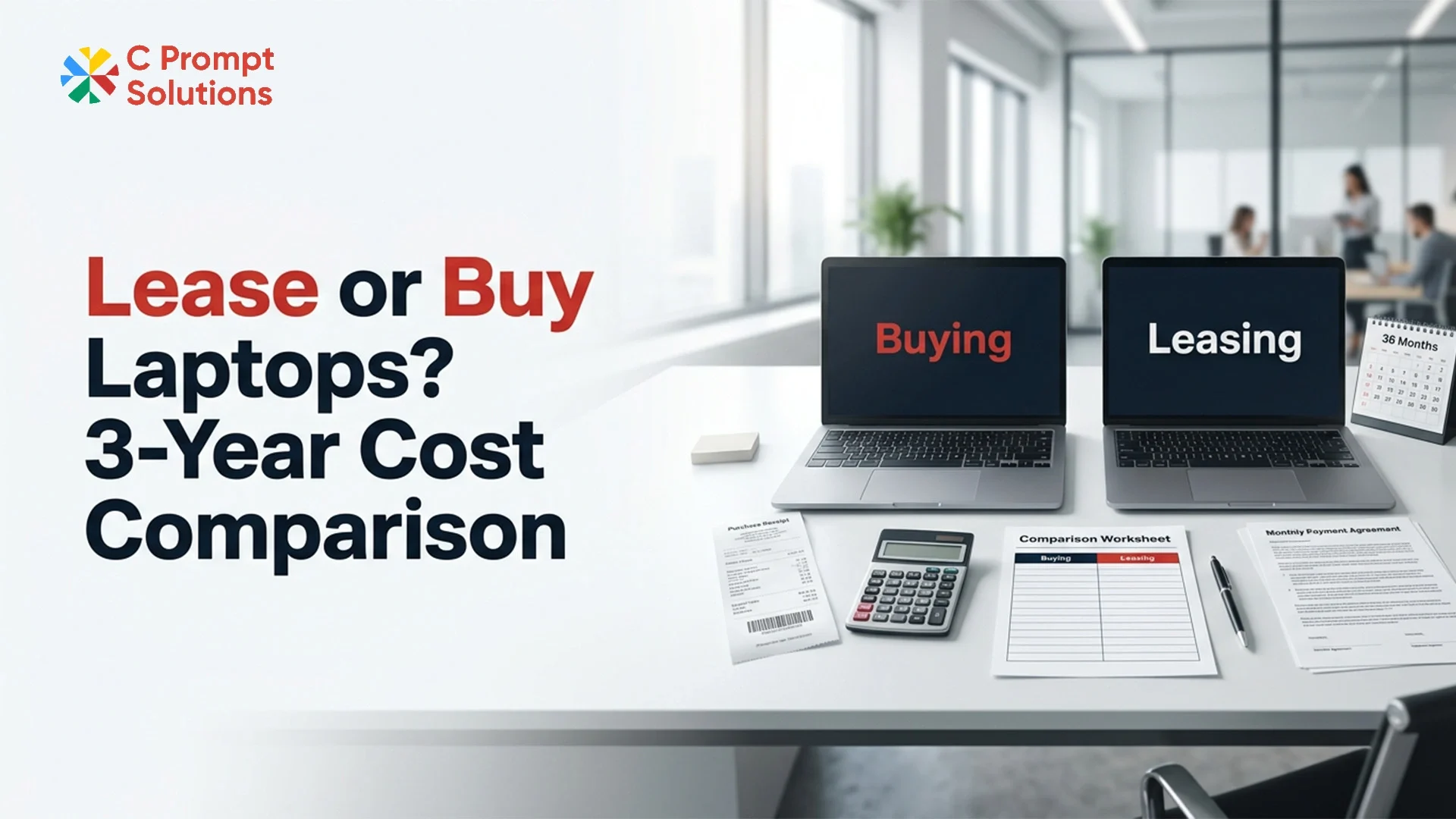
What belongs in a lease or buy laptop worksheet?
A lease or buy laptop worksheet needs one row for every cost the fleet creates over 36 months, filled in for both options on the same scope. Purchase records and IT timesheets feed the buy column, while the lease column needs a written quote. Leave no cell blank. Mark each one as included, priced, or missing.
Cost line | Buy column | Lease column |
|---|---|---|
Hardware | Invoice price per laptop, before GST | Monthly rent for all 36 months |
Setup and imaging | Staff hours or a vendor charge | Included, or a one-time charge |
Support cost after warranty | Extended warranty for the uncovered months | Support scope written in the quote |
Repairs and spares | Parts, plus the spare units you hold | Replacement time stated in the contract |
Internal IT time | Hours per laptop at your hourly cost | Hours your team still spends |
Cost of capital | Upfront cash at your borrowing rate | Small, since payments are monthly |
Data wipe at exit | Wipe and disposal, with a record | Who wipes and who issues the record |
Resale value at month 36 | A written offer, deducted | Not applicable, laptops go back |
Give the sheet two owners, IT for setup and hours and finance for the money rows. Then have both sign it.
How do you price ownership cost honestly?
Ownership cost is the purchase price plus every hour and rupee spent keeping a laptop working until it leaves the business. Little of that appears on the hardware invoice, so a lease quote can look expensive next to a purchase order simply because the purchase order leaves those lines out.
Price each of these from your own records:
Support cost after warranty. If the standard warranty ends before month 36, take the remaining months from a real extended-warranty quote.
Internal hours. Count imaging, handover to the user, fault logging, and reassignment when someone leaves.
Spares. A failed laptop with no spare on the shelf costs that employee a working day.
Data wipe. Every retired laptop needs wiping to NIST's media sanitization guidelines or a similar standard, with a record.
Resale value. Ask a refurbisher for a written offer on a 3-year-old laptop from the same model family.
Hours are the line a lease or buy laptop comparison most often skips. Nobody budgets for them. Here is an illustrative example: a 40-laptop office where IT spends 3 hours per laptop each year on setup and fault calls. Over 36 months, that comes to 360 hours, roughly 45 working days of one person's time. Put that figure in the buy column at your real hourly cost, then check how many of those hours the lease quote would remove.
How does capex vs opex IT accounting change the comparison?
Buying puts laptops on the fixed asset register as capital spend, depreciated over the useful life your books use. Leasing turns the same fleet into monthly payments. Which label the lease carries depends on your accounting standards.
Companies on Ind AS follow Ind AS 116. ICAI's Ind AS 116 summary says the standard requires a lessee to recognise assets and liabilities for leases longer than 12 months, unless the underlying asset is of low value. Whether a laptop fleet counts as low value is a judgement for your auditor. Ask early.
Smaller companies reporting under the older Accounting Standards follow their own lease rules. Either way, the capex vs opex IT choice moves the spend to a different line of the accounts. The cost itself stays the same. Settle the lease or buy laptop totals first and the presentation second.
How do GST and TDS differ between buying and leasing?
In a lease or buy laptop comparison, GST applies either way, usually at 18% on laptops and on lease rent, so it shifts cash flow more than total cost. A 40-laptop purchase means paying the full price plus GST upfront, then waiting for the credit. A lease spreads the rent and the GST across monthly invoices for the whole term.
Two points to confirm with your accounts team:
Input tax credit. Credit depends on the conditions in CGST Act Section 16, so registration alone does not guarantee it. Check the current rate on the CBIC GST rates page.
TDS on lease rent. Rent for equipment falls under Income-tax Act Section 393 from 1 April 2026. The rate is 2% once rent crosses ₹50,000 for a month or part of a month. Your company withholds it from the payment, so it adds nothing to the lease column.
When does refresh timing tip the answer?
Refresh timing tips the answer when bought laptops stay in service long past their useful life. A purchase has no end date. Replacement waits for a fresh budget. A lease fixes the refresh date at signing, which turns a yearly argument into a date on the calendar.
Older laptops cost money in ways the asset register never shows. Batteries fade, and repairs take longer as parts get scarcer. Staff wait on slow machines several times a day. Nobody books those minutes.
Buying still wins on light work. An accounts executive on email and spreadsheets can get 5 good years from a well-built business laptop.
When should a business buy laptops, and when should it lease?
Buy when laptops stay in use for 4 years or more, and the business has spare cash plus an IT team that handles setup and disposal well. Lease when headcount moves, or when cash flow matters more than owning the hardware.
Buying fits when:
Laptops run 4 to 5 years on light workloads
Cash is available at a low cost of capital
Headcount stays flat through the year
Policy says drives never leave your premises
Leasing fits when:
The business wants one fixed monthly figure per device
Hiring adds seats mid-year, sometimes 10 or 15 at a time
The IT team is 1 or 2 people
A planned refresh at month 36 matches the useful life in the books
Under C Prompt's Lease on Contract, terms run from 2 to 5 years, and added laptops join at the same fixed rate and end with the rest of the fleet. A failed laptop is swapped the same business day in 8 hub cities. The guide to leasing laptops for a business fleet covers term choice in detail.
Is rent vs buy laptop a different question for short needs?
Yes. For needs shorter than about a year, the rent vs buy laptop question has a quicker answer. A 4-month project, a training batch, or a temporary audit team rarely justifies a purchase, because a nearly new laptop sells for well below its invoice price.
Monthly rental keeps the commitment short. The Monthly Rentals plan from C Prompt delivers within 24 hours in its hub cities, and the laptop rental range runs from i3 to i7 builds. The laptops go back when the project ends.
Frequently asked questions
Is it cheaper to lease or buy laptops over 3 years?
That depends on which lines your team really pays for. If IT already handles setup and spares cheaply, buying often comes out lower over 36 months. A lease covering those jobs can cost less in total when they pull in outside vendors or take 3 or more hours per laptop a year.
Does leasing laptops count as an operating expense?
Not automatically. Under Ind AS 116, leases longer than 12 months usually come onto the balance sheet unless the laptops qualify as low-value assets. That call belongs to your auditor. Get the treatment in writing before presenting the lease to the board as opex.
What resale value should we expect for 3-year-old laptops?
Ask a refurbisher for a written offer on the exact model family, in the condition you expect after 36 months of office use. Enter that figure, less the cost of a certified wipe, in the buy column. Prices copied from listing sites flatter ownership, because they assume healthy batteries and no keyboard wear. Use the lower of the two offers.
Is TDS deducted on laptop lease payments?
Yes, at 2% for equipment once a month's rent passes ₹50,000, under Section 393 of the Income-tax Act, 2025 from 1 April 2026. Your accounts team withholds it from the payment, so the lessor's quote and your total cost stay unchanged.
What happens to leased laptops at the end of the term?
About 90 days before the end date, C Prompt raises three routes. You can refresh onto current laptops on a new term, or return the fleet with certified data wiping. The third route moves it to fully managed Device as a Service.
Put every cost on one sheet, for the same 36 months, before anyone compares monthly figures. Once support cost, hours, resale value, and tax sit side by side, the lease or buy laptop answer for your own fleet is usually plain to see.