
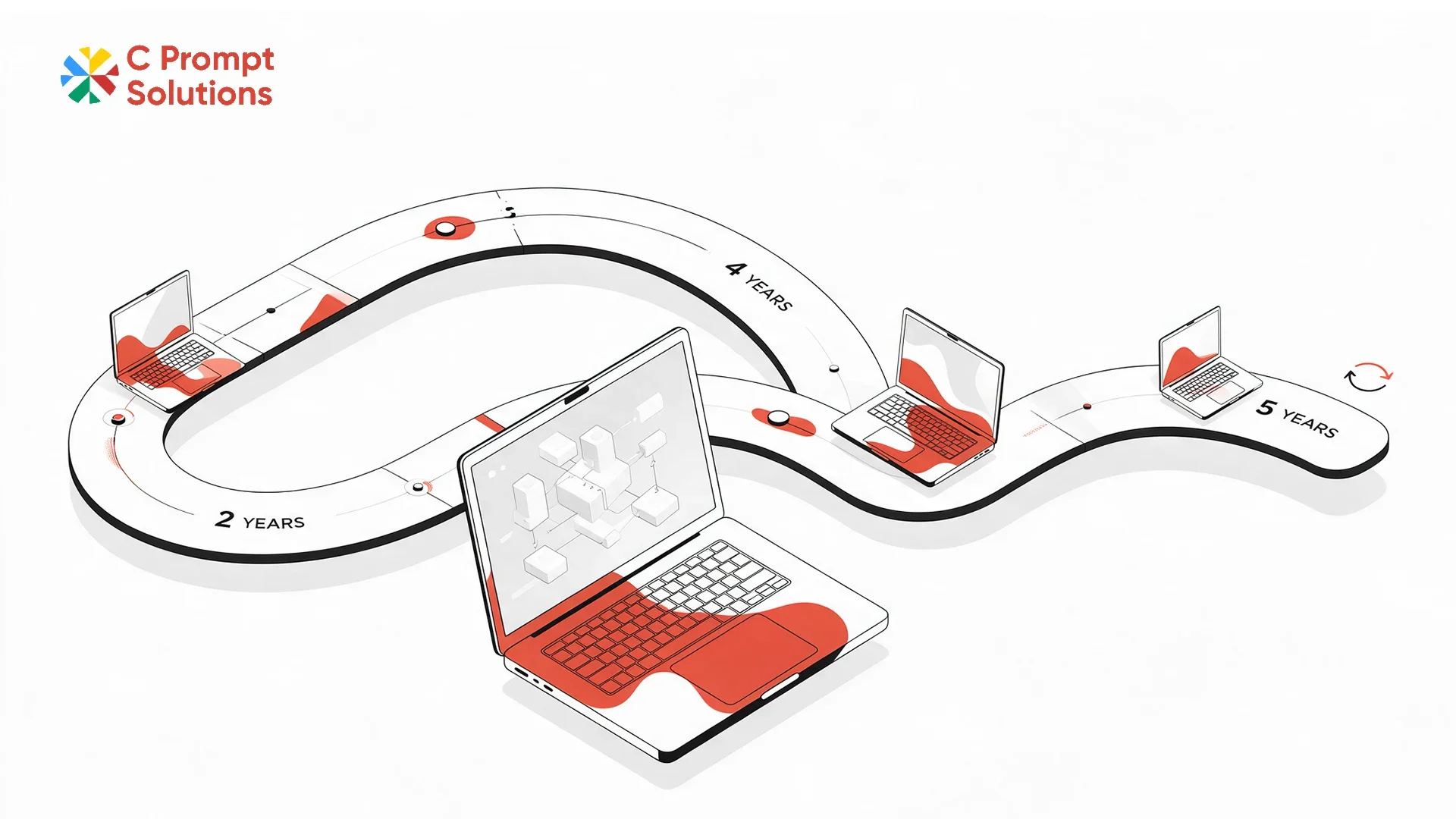
Schedule II of the Companies Act, 2013 sets the useful life of laptops and other end-user devices at 3 years. That falls short of a 5-year lease term. A finance team that decides to lease laptops for business across 2 to 5 years needs a plan for what happens once the hardware ages past that statutory life. A monthly figure that fits the budget is only part of the picture. This guide walks through the decisions that keep a multi-year lease predictable, from term length to contract review.
Choosing a Two to Five Year Term
A two- to five-year term should track how long the business expects to run on the same operating model. It should not be picked for the lowest monthly amount on offer. A shorter term inside that range carries a higher monthly amount but less exposure if the business changes shape.
A longer term on C Prompt's Lease on Contract plan locks in a lower monthly amount, with less flexibility to adjust if headcount or strategy shifts. Confirm what happens if the business needs to exit the term early before committing to the long end of the range.
The Monthly Amount Should Stay Fixed for the Full Term
A laptop leasing agreement is built around one fixed monthly amount per device for the length of the term. Confirm in writing that this amount does not move with market pricing, fuel costs, or currency shifts over 2 to 5 years. A lease that allows mid-term rate revisions is not offering the predictability that leasing is meant to provide in the first place.
Role-Based Configuration Across a Multi-Year Fleet
A multi-year fleet rarely runs on one spec. Role-based configuration matches processor generation, RAM and storage to what each function actually needs. Developers and designers typically need higher-spec machines than admin or support roles. Set this at the order stage, not after devices arrive, since reconfiguring a leased fleet mid-term is slower than specifying it correctly the first time.
Device Schedule Is the Working Record of the Lease
The device schedule lists every device on the lease: make, model, processor generation, RAM, storage and serial number. On a 2- to 5-year term, this document is what both sides refer back to. That includes every review point, every added seat, and the final return. A device schedule that is not kept current after each change becomes unreliable exactly when it is needed most, at the end of the term.
Support Scope Over a 2 to 5 Year Lease
Support scope should be defined for the full term, beyond the first year alone. Confirm whether replacement SLAs, on-site support and configuration help stay the same in year four as they were in year one. A lease that is generous with support at signing and vague about year three onward is worth pushing back on before the contract is finalised.
- Replacement SLA confirmed as unchanged across the full term, in writing
- On-site or remote support scope specified for every year, not only the first
- A named point of contact for support requests, not a rotating ticket queue
Additional Seats as the Business Grows
A 2- to 5-year lease should allow additional seats to join partway through the term. Price them on the same schedule as the original order, not as a separate negotiation each time. Confirm whether added seats run on the same end date as the rest of the fleet or start their own term. Fleets that add seats piecemeal without aligning end dates often end up with a dozen different renewal dates within a few years.
Refresh Planning Around the Useful Life
Refresh planning matters more on a 5-year lease than a 3-year one, since the hardware's statutory 3-year useful life falls inside the term. Ask whether the lease includes a scheduled refresh partway through, or whether devices run the full term regardless of age. A mid-term refresh option, even at extra cost, is worth pricing against the alternative of running ageing hardware through years four and five.
Contract Review Points, Beyond Renewal
A 2- to 5-year lease benefits from scheduled review points, not only a renewal conversation at the very end. Build in a check at the midpoint: confirm the device schedule is current, support scope is holding, and the role mix still matches the actual team. A lease reviewed only at renewal tends to surface problems that had been building for years, all at once.
- Device schedule matches what is actually deployed, not what was ordered at signing.
- Support scope and replacement SLA unchanged from the original agreement
- Role mix still reflects the current team, not the team from year one
GST and TDS on a Laptop Leasing Invoice
GST applies at 18% under CBIC Notification 11/2017-Central Tax (Rate), shown as a separate line on every invoice across the full lease term. Once monthly rent to a single vendor crosses ₹50,000, Section 194-I requires 2% TDS to be deducted before payment. Confirm both lines on a sample invoice before signing a term that runs several years, since a tax treatment error compounds every month it goes unnoticed.
Laptop Leasing for Small Business Looks the Same, at Smaller Scale
Laptop leasing for small business runs on the identical contract structure as a large enterprise lease. Term length, fixed monthly amount, device schedule and support scope all stay the same. What changes is the device count and, sometimes, the role mix. A ten-device lease for a small business does not need a different set of questions from a five-hundred-device enterprise fleet. It only needs smaller numbers on the same schedule. Ask a vendor whether pricing or support scope changes meaningfully below a certain device count. Some providers apply weaker terms to smaller orders without stating this upfront.
Setup Charges on a Multi-Year Lease
Setup charges cover imaging, asset-tagging and configuration before the first batch ships. On a lease running 2 to 5 years, confirm whether this is a one-time charge for the initial fleet, or whether it applies again to every added seat. A vendor that waives setup on the original order but charges full setup on every addition changes the real cost of scaling the fleet over the term.
Frequently Asked Questions
How long should a laptop leasing term run?
Most business leases run 2 to 5 years. Match the term to how long the business expects to run on the same operating model, not the lowest monthly amount on offer.
Does the monthly amount change over a multi-year lease?
It should not. Confirm in writing that the monthly amount is fixed for the full term, regardless of market pricing shifts.
Can I add laptops to the lease partway through the term?
Yes, most laptop leasing agreements allow additional seats mid-term. Confirm whether they run on the same end date as the original fleet or start a separate term.
Is laptop leasing for small business different from a large enterprise lease?
The contract structure is the same. What usually differs is device count and role mix, not the term length, support scope or tax treatment.
What happens to the hardware at the end of a 5-year lease?
This should be defined in the contract: return, refresh, or an end-of-term purchase option. Confirm the return condition standard well before the final year begins.
Is GST charged on laptop leasing?
Yes, at 18%, shown as a separate line on the invoice across the full term. Registered businesses can claim input tax credit on this amount.
Can a laptop leasing agreement be terminated before the term ends?
Most agreements allow early termination, usually with a charge calculated on the months remaining. Confirm this figure before signing if the business timeline is uncertain over a 2 to 5 year horizon.
Does setup get charged every time seats are added to the lease?
It depends on the vendor. Confirm this upfront rather than after the first added batch, since a setup charge on every addition changes the real cost of scaling the fleet over a multi-year term.
Leasing laptops for business comes down to eight decisions. Term length, a fixed monthly amount, role-based configuration, an accurate device schedule, support scope, additional seats, refresh planning, and scheduled contract review. Get these right at signing, and a 2- to 5-year fleet stays predictable instead of becoming a source of surprises in year four.