
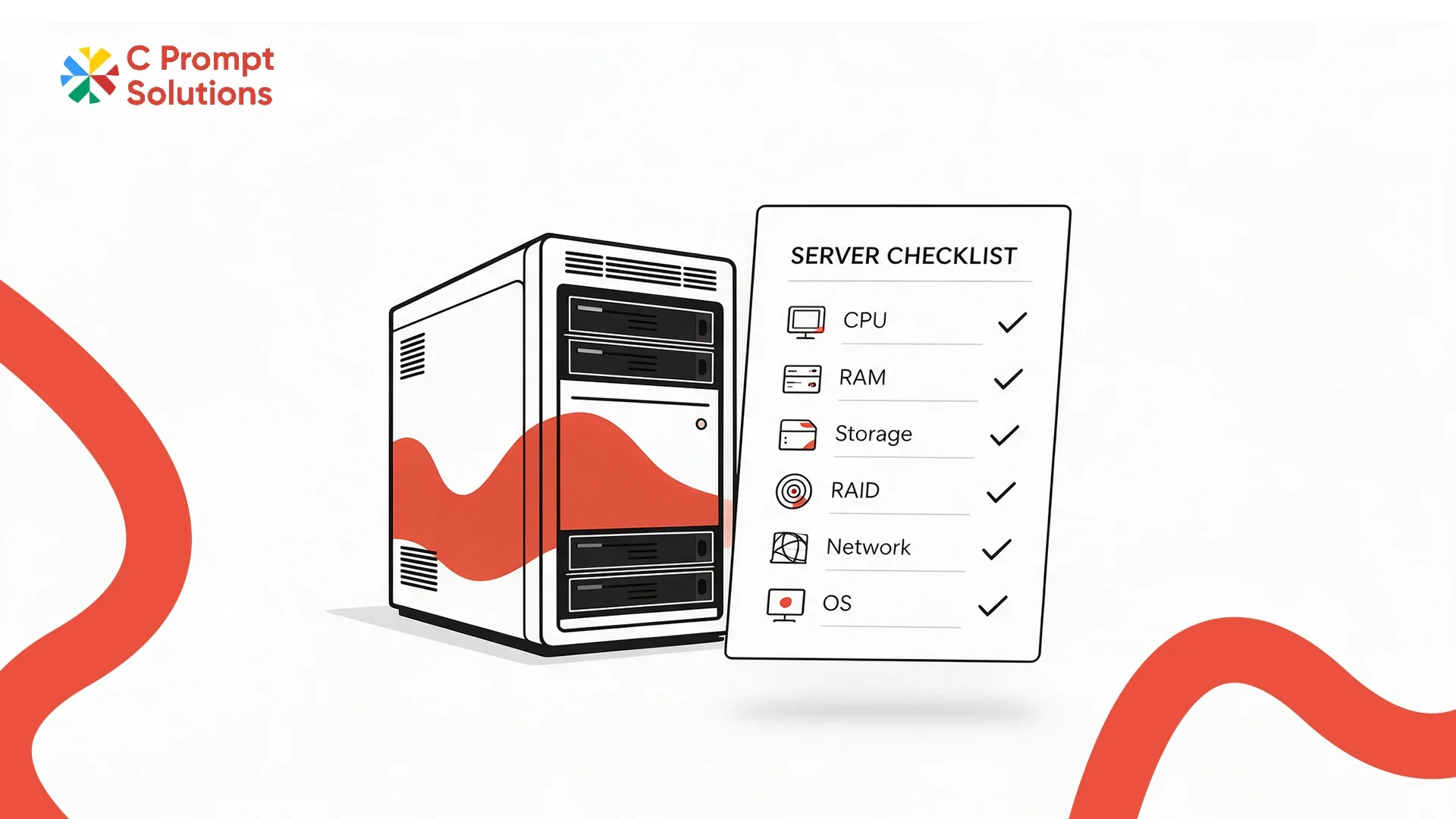
Section 160 of the Indian Contract Act, 1872 requires a bailee to return rented equipment once the agreed period ends, without a separate demand from the owner. That return obligation, and the installation before it, both depend on a specification being right the first time. A physical server rental ordered against a vague brief usually arrives wrong on at least one line: form factor, cores, memory or storage. This checklist runs through what to specify before requesting a quote.
Rack or Tower Sets the Physical Fit
Rack or tower is the first decision, and it depends entirely on where the server actually goes. A data room with existing racks needs rack-mount units in a stated U height, not a tower that will not fit the cabinet. An office without a dedicated data room usually needs a tower or a small rack enclosure instead. State the physical space and any existing rack infrastructure before a vendor quotes hardware.
- Rack-mount: confirm U height and rail compatibility with the existing cabinet
- Tower: confirm floor or desk space and noise tolerance for the location
- Neither installed yet: confirm whether the vendor supplies rack or enclosure too
Processor Cores for the Actual Workload
Processor cores should be specified against the actual workload, not a round number that sounds sufficient. A database server handling concurrent queries needs a different core count than a file server mostly serving static storage. State what the server runs, virtualisation included, since a hypervisor hosting several virtual machines needs more cores than a single-purpose physical box.
Memory Sized for Peak Load, Not Average Load
Memory should be sized against peak load, not the average day. A server that runs most of the time comfortably but chokes during month-end processing or a backup window was specified against the wrong number. State the heaviest regular load the server needs to handle, and size memory against that, with headroom rather than an exact match.
Usable Storage vs Raw Storage
Usable storage is the figure that matters, not the raw capacity printed on the drive labels. RAID configurations, whichever level is chosen for redundancy, reduce the usable figure below the sum of the raw drives. State the usable storage needed after redundancy. Confirm which RAID level the quoted figure already accounts for, since two quotes citing the same raw capacity can offer very different usable space.
- State usable storage after RAID, not raw drive capacity before redundancy
- Confirm which RAID level the vendor has assumed in the quoted figure
- Ask whether storage can be expanded later without a full server swap
Network Interfaces Needed for the Environment
Network interfaces should match the environment the server plugs into, not a generic single-port default. A server handling significant network traffic, or one that needs redundant connections for uptime, needs multiple network interface cards specified upfront. State the number of ports needed and whether link redundancy matters for this particular deployment.
Power and Cooling Change What a Room Can Actually Support
Power and cooling should be confirmed against the room the server goes into. This should never be assumed to be a non-issue for a single unit, even on C Prompt's Monthly Rentals plan. A small office space without dedicated cooling can struggle with even one rack-mount server running under load for extended periods. State the room's existing power outlets and any cooling already in place so that the vendor can flag a mismatch before delivery rather than after.
Onsite Installation Should Be Scoped, Not Assumed
Onsite installation should be scoped explicitly. Confirm whether the vendor racks and cables the unit, configures the operating system, and tests it before handover, or simply delivers a box to the door. Confirm this before the delivery date is fixed. A data room without in-house hands to rack a server needs the installation service built into the order, not added as an afterthought once the box has already arrived.
Project End Date Sets the Rental Term
Project end date should set the rental term for a physical server rental the same way it does for any monthly rental. Confirm the exact end date with whoever owns the project, and check the minimum term before ordering if the project might close early. Ending before the minimum term rarely reduces the bill, so plan the order date around it.
GST and TDS on a Physical Server Rental
GST applies at 18% under CBIC Notification 11/2017-Central Tax (Rate), shown as a separate line on the invoice regardless of specification tier. Once monthly rent to a single vendor crosses ₹50,000, Section 194-I requires 2% TDS to be deducted before payment. Confirm both lines on a sample invoice before the order ships, since a high-spec server changes the monthly figure these percentages apply to.
Documents Required for a Physical Server Rental
Signing a physical server rental agreement needs the same standard KYB documents as any other IT equipment rental: company PAN, GST registration, and the signing authority's identification and authorisation letter. An IT team already coordinating a data room build or office move should confirm this list early, so paperwork does not delay installation once the room itself is ready.
Replacement SLA for a Server Is Different From a Laptop
Replacement SLA on a physical server rental works differently from a laptop swap, since a server failure can take down infrastructure a whole team depends on. Confirm whether the vendor holds spare units pre-configured close to the deployment city, or whether a failed server triggers a fresh build-and-ship cycle. The second option can mean days of downtime that a pre-configured spare would avoid entirely.
- Ask whether spare units are pre-configured or built on demand after a failure.
- Confirm the replacement SLA in hours for the specific deployment city
- Ask what happens to data on the failed unit during the swap
Server Rental for Business vs On-Premise Server Rental
Server rental for business and on-premises server rental describe the same equipment, viewed from two angles. One looks at the commercial arrangement. The other looks at where the hardware physically sits. Both come down to the same specification checklist: form factor, cores, memory, storage, network, power, and installation. Neither term changes what needs to be confirmed before a quote is finalised.
Frequently Asked Questions
Should I choose rack or tower for a small office server room?
This depends on whether the space has existing rack infrastructure. A dedicated data room usually favours rack-mount; an office without one often works better with a tower.
How do I know how many processor cores a physical server rental needs?
Base it on the actual workload, including virtualisation. A hypervisor running several virtual machines needs more cores than a single-purpose server.
What is usable storage, and why does it differ from raw storage?
Usable storage is the capacity left after RAID redundancy is applied. Two quotes with the same raw drive capacity can offer different usable space depending on RAID level.
Does a physical server rental include onsite installation?
Not always. Confirm whether racking, cabling, OS configuration and testing are included, or whether the vendor only delivers the hardware.
Is GST charged on a physical server rental?
Yes, at 18%, shown as a separate line on the invoice. Registered businesses can claim input tax credit on this amount.
Can a server be added to an existing rental mid-project?
Yes, most monthly rental agreements allow this. Confirm how quickly an added server can arrive and whether it runs to the same end date as the original order.
What documents are needed to sign a physical server rental agreement?
Standard KYB documents: company PAN, GST registration, and the signing authority's identification and authorisation letter. Confirm this list early if the order is tied to a room build or office move.
How fast can a failed server be replaced?
This depends on whether the vendor holds pre-configured spares near the deployment city. Confirm the exact replacement SLA in hours, not a general same-day promise.
A physical server rental specification checklist comes down to seven items: form factor, processor cores, memory, usable storage, network interfaces, power and cooling, and onsite installation. Confirm all seven, along with the project end date, before requesting a final quote.