
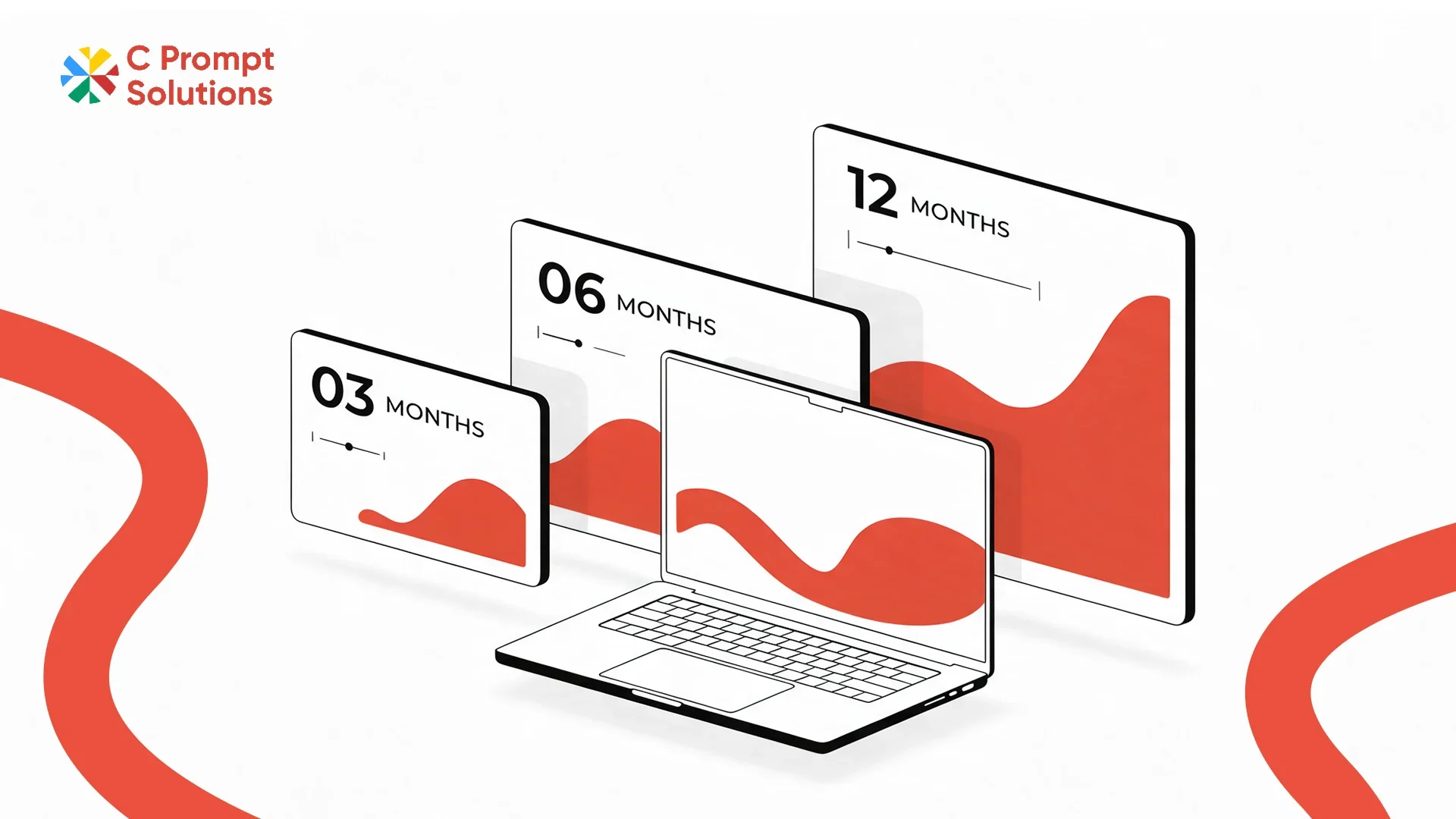
Section 160 of the Indian Contract Act, 1872 requires a bailee to return rented equipment once the agreed period ends, without waiting for a separate demand. A monthly laptop rental tied to a 3-, 6-, or 12-month project should be planned around that end date from the day the order is placed. Most friction in a rental term shows up at the edges: the start, the extension point, and the return, not in the middle of the contract. This guide walks through the decisions that keep a monthly laptop rental aligned with a project timeline, from minimum month to final collection.
Project End Date Should Set the Rental Term
A monthly laptop rental should be ordered against the actual project end date, not a round number picked for convenience. A project scheduled to close in eleven weeks does not need a rental rounded up to four months by default. Confirm the exact end date with the project lead before requesting a quote. Vendors price against full months, not weeks, and a term that overshoots the project by even one month adds a full extra billing cycle.
Minimum Month Sets the Floor
Monthly laptop rental agreements carry a minimum month, the shortest period a vendor will bill for, typically one month. A two-week pilot still bills as one full month under most rental structures. Confirm this floor before signing if the project might close early. Ending before the minimum month rarely reduces the bill, so plan the order date around it rather than around the project kickoff meeting.
Extension Notice Keeps a Long-Term Laptop Rental Simple
Projects run long more often than they run short. A monthly laptop rental that turns into a long-term laptop rental needs an extension notice clause agreed upfront. Confirm how many days before the current term ends, and to whom the notice goes. Confirm this before the first invoice, not when the project is already three weeks from its original end date. A missed notice window can force a full new order instead of a simple extension.
Quantity Changes Mid-Project
Project teams grow and shrink. A monthly laptop rental on C Prompt's Monthly Rentals plan allows quantity changes mid-term. Devices can be added when headcount rises, and returned early when a role ends, without renegotiating the whole contract. Confirm how quickly added devices can arrive, and whether returned devices reduce the bill from the return date or only from the next billing cycle.
- Added devices billed from their own delivery date, not the original order date
- Returned devices credited from the collection date, confirmed in writing
- The same configuration available for added devices, not a different spec
Billing Cycle, GST and TDS on a Monthly Laptop Rental
A monthly laptop rental typically bills on a fixed cycle, either the calendar month or the anniversary of the delivery date. Confirm which one applies, since it changes when quantity changes and extensions actually take effect on the invoice. GST applies at 18% under CBIC Notification 11/2017-Central Tax (Rate), shown as its own line. Once monthly rent to a single vendor crosses ₹50,000, Section 194-I requires 2% TDS to be deducted before payment. Confirm both lines on the sample invoice before the project starts, not after the first bill arrives.
Collection Date and Project Handover
The collection date should be fixed in the contract before the project reaches its final week. It should not be arranged over email once the team is already packing up. Project handover, the point where the project team confirms devices are ready for return, should happen a few days before collection. This gives time to back up data and confirm the return condition. A collection date treated as a formality tends to slip into the next billing cycle.
- Fix the collection date in the contract, not by email close to the end date.
- Schedule project handover a few days before collection, not on the same day
- Confirm the return condition standard before the handover date, not during it.
Fixed Configuration Keeps the Project on Schedule
A monthly laptop rental for a single project runs smoother on a fixed configuration. That means the same processor generation, RAM and storage across every device for the full term. Mixed specs mid-project create performance differences that project leads often mistake for a person problem. Lock the configuration once, at the order stage. Treat any replacement as a same-spec swap, not an upgrade.
Setup Charges on a Monthly Laptop Rental
Setup charges cover imaging, asset-tagging and configuration before dispatch. Some vendors itemise this separately per device. Others fold it into the monthly amount. Ask which applies before comparing two quotes on the headline monthly figure alone. A lower number that hides setup charges elsewhere is not the cheaper rental once the full term is priced in.
A Laptop Rental Extension vs a New Order
A laptop rental extension keeps the same devices, the same configuration and the same billing history running past the original end date. A new order resets all three: new devices, a new minimum month, and a fresh invoice cycle. Ask the vendor which applies by default when a project runs long. Some vendors treat any extension past a set threshold as a new order automatically. This matters for anyone comparing a rental extension against a long-term laptop rental from the start.
When a Monthly Laptop Rental Becomes a Long-Term Laptop Rental
Some projects do not have a clean end date. A monthly laptop rental ordered for three months that keeps extending every quarter functions as a long-term laptop rental in practice. That holds even if it was never planned that way. At this point, it is worth reviewing the rate card. Bulk and duration discounts on a long-term laptop rental sometimes beat renewing at a short-term rate every quarter. Ask the vendor to re-quote the full remaining period once a rental has extended twice. This beats continuing to renew month by month on the original short-term pricing.
Frequently Asked Questions
What is the minimum term for a monthly laptop rental?
Most vendors set it at one month. A rental ordered for two weeks or less still bills as a full month under most rental structures, so plan the start date accordingly.
How much notice do I need to give to extend a monthly laptop rental?
This varies by vendor, so confirm the exact number of days in writing before the first invoice. Missing the notice window can force a new order instead of a simple extension.
Can I add more laptops partway through a project?
Yes, most monthly laptop rental agreements allow quantity changes mid-term. Confirm how quickly added devices arrive, and whether they bill from their own delivery date.
Does a laptop rental extension need a new agreement?
Usually not, provided the extension notice is given within the agreed window. Some vendors treat an extension past a certain length as a new order, so confirm this threshold upfront.
What happens if the project ends early?
The collection date moves up, but the minimum month still applies. Ending before the minimum term rarely reduces the total bill for that period.
Is GST charged on a monthly laptop rental?
Yes, at 18%, shown as a separate line on the invoice. Registered businesses can claim input tax credit on this amount.
At what point should I ask for a long-term laptop rental rate instead of renewing monthly?
Once a rental has been extended two or three times, ask for a re-quote on the full remaining period. A long-term laptop rental rate often beats stacking short-term renewals, especially on larger device counts.
Do quantity changes reset the minimum month for added devices?
Usually not. Added devices typically run to the same end date as the rest of the fleet, rather than starting their own fresh minimum month. Confirm this with the vendor, since a few structure it the other way, which extends the term further than planned.
A monthly laptop rental for a 3, 6 or 12-month project comes down to eight decisions. The end date, the minimum month, extension notice, quantity changes, billing cycle, collection date, configuration, and how an extension differs from a new order. Confirm all eight before the order ships, not after the project is already underway.