
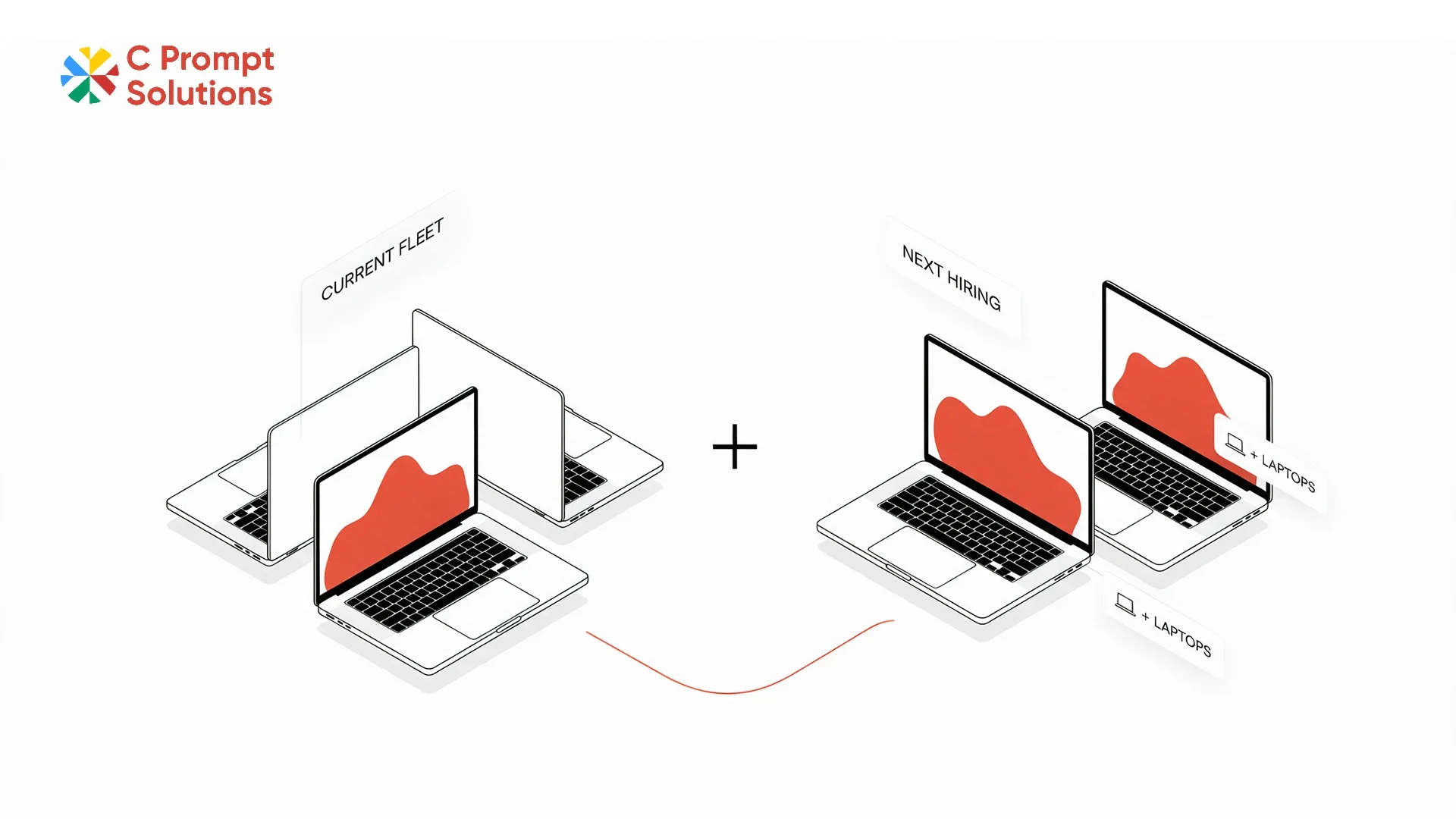
Section 80-IAC of the Income Tax Act, 1961 lets a DPIIT-recognised startup claim a 100% profit tax exemption for three years. That benefit is about profit, not the upfront cost of equipping a team. A laptop rental for startups solves the second problem: getting a hiring plan turned into a working fleet without a capital outlay. This guide walks through the first rental batch and the decisions that keep the fleet scaling cleanly through the next hiring round.
Hiring Plan Should Set the First Rental Batch
A hiring plan, even a rough one, should decide the first rental batch before a single quote is requested. Order against the headcount expected in the next 60 to 90 days, not the headcount today. A batch sized only for the current team gets outgrown within a month at most early-stage hiring speeds, forcing a second order before the first invoice even arrives.
Role-Based Devices, Even at Five People
Role-based devices matter at five employees the same way they matter at fifty. Engineers typically need higher RAM and faster storage than a founder handling sales and admin from the same laptop. Specify two or three configurations at the first rental batch, rather than one flat spec. Early hires should not have to work around hardware that does not fit their role.
- Engineering and product roles: higher RAM, SSD storage, dedicated graphics if needed
- Founder, sales and admin roles: entry to mid-spec configurations
- One shared spare device, imaged and ready, for a new hire who starts unexpectedly
A Mixed Fleet From the Start
A mixed fleet, laptops alongside a couple of desktops or monitors for a home base or small office, is common even for a five-person startup. Ask whether all equipment types sit on one contract and one invoice, rather than separate orders per device category. Splitting a small order across two contracts adds paperwork with no benefit at this scale, and it usually means two separate points of contact for support instead of one.
Changing Headcount After the First Batch
Changing headcount is the normal state for a startup, not an exception to plan around. Confirm how quickly added devices can arrive once a new hire is confirmed, and whether they run to the same rental term as the original batch. A vendor with no seat minimum lets a fleet grow one device at a time. C Prompt's Monthly Rentals plan has no minimum order size forcing a round number.
Extension Terms as the Startup Scales
Extension terms decide what happens when the original rental period ends and the startup is still using the same devices. That is the common outcome, not the exception. Confirm the notice window for extending, and whether the rate improves once the fleet has grown past the original order size. A startup renting ten devices in month one and forty by month twelve should not still be paying the ten-device rate card.
Monthly Invoice Should Be Easy to Reconcile
A monthly invoice for a growing fleet should list devices by batch or addition date, not as one undifferentiated total. This is what a founder or a first finance hire reconciles against actual headcount each month. GST applies at 18% under CBIC Notification 11/2017-Central Tax (Rate), shown as its own line. Once monthly rent to a single vendor crosses ₹50,000, Section 194-I requires 2% TDS deducted before payment.
One Support Contact, Not a Ticket Queue
A support contact matters more for a startup than for a large enterprise with its own IT team. Confirm there is one named contact or account owner for the fleet, not a generic ticket queue that starts from zero context on every call. A startup calling about a failed laptop the night before a demo needs someone who already knows the account, not someone reading it for the first time.
Documents Required for a Business Laptop Rental
A business laptop rental for a newly incorporated startup needs the same standard KYB documents as any other company: PAN, GST registration, and the signing authority's identification and authorisation letter. A startup still completing GST registration should confirm with the vendor whether an order can proceed on incorporation documents alone. GST details can be added once registration is complete. Waiting on paperwork should not delay a hiring round already in motion.
Setup Time Matters More at Startup Speed
Setup time on a business laptop rental matters more for a startup than for a larger company with slack in its hiring timeline. Confirm whether devices arrive preconfigured with a base image, or whether the founding team configures each one after delivery. A startup issuing its fifth hire a laptop the same week they accept an offer cannot absorb a full day of manual setup per device.
Comparing Quotes at Five Devices vs Fifty
A business laptop rental quote for five devices should still be compared line by line, the same way a fifty-device order would be. Check the same items: spec per role, setup charges, replacement SLA, and whether GST and TDS are itemised separately. A small order is not exempt from the line items that make a larger order predictable. It is simply cheaper to get it wrong at this stage than to discover the same gap once the fleet has tripled.
An IT Equipment Rental for Startups Beyond Laptops
IT equipment rental for startups covers more than laptops once the team grows: monitors, networking gear, and eventually servers for anything run in-house rather than on cloud infrastructure. Ask whether these can be added to the same contract as the laptop fleet, on the same invoice. This avoids opening a second vendor relationship for each new equipment type.
Frequently Asked Questions
How many laptops should a startup order in its first rental batch?
Order against the headcount expected in the next 60 to 90 days, beyond just the team today. Add one spare device for an unplanned hire.
Is there a minimum order size for a business laptop rental?
Not with every vendor. Confirm this specifically, since a seat minimum can force a five-person startup to round up to an order size it does not need yet.
Can devices be added quickly when a new hire is confirmed?
Yes, most monthly rental agreements allow this. Confirm the delivery timeline for an added device against the new hire's actual start date.
Do extension terms improve as the fleet grows?
They can, but only if asked for directly. Confirm whether the rate card is reviewed once the fleet has grown well past its original order size.
Is GST charged on a laptop rental for startups?
Yes, at 18%, shown as a separate line on the invoice. Registered businesses can claim input tax credit on this amount.
Can a startup rent monitors and networking gear on the same contract as laptops?
Yes, most vendors run a mixed fleet on one contract and one invoice, which is simpler to manage than separate vendors per device type.
What documents does a newly incorporated startup need for a business laptop rental?
Standard KYB documents: company PAN, GST registration, and the signing authority's identification and authorisation letter. Confirm whether an order can start on incorporation documents alone while GST registration is completed.
Is a five-device order worth comparing as carefully as a fifty-device one?
Yes. The same line items, spec, setup, replacement SLA and tax treatment decide the real cost regardless of order size. Gaps found at five devices are cheaper to fix than at fifty.
Does a startup need a different agreement for laptops vs monitors or networking gear?
No, if the vendor supports a mixed fleet. One agreement with one device schedule covering every equipment type is simpler than a separate contract per category, even at small scale.
A laptop rental for startups starts with a hiring plan and a first rental batch sized to it, not the team of today. Everything after that exists to keep the fleet scaling as fast as the hiring round does. Role-based devices, a mixed fleet, changing headcount, extension terms and a clean monthly invoice all follow from that first decision.