
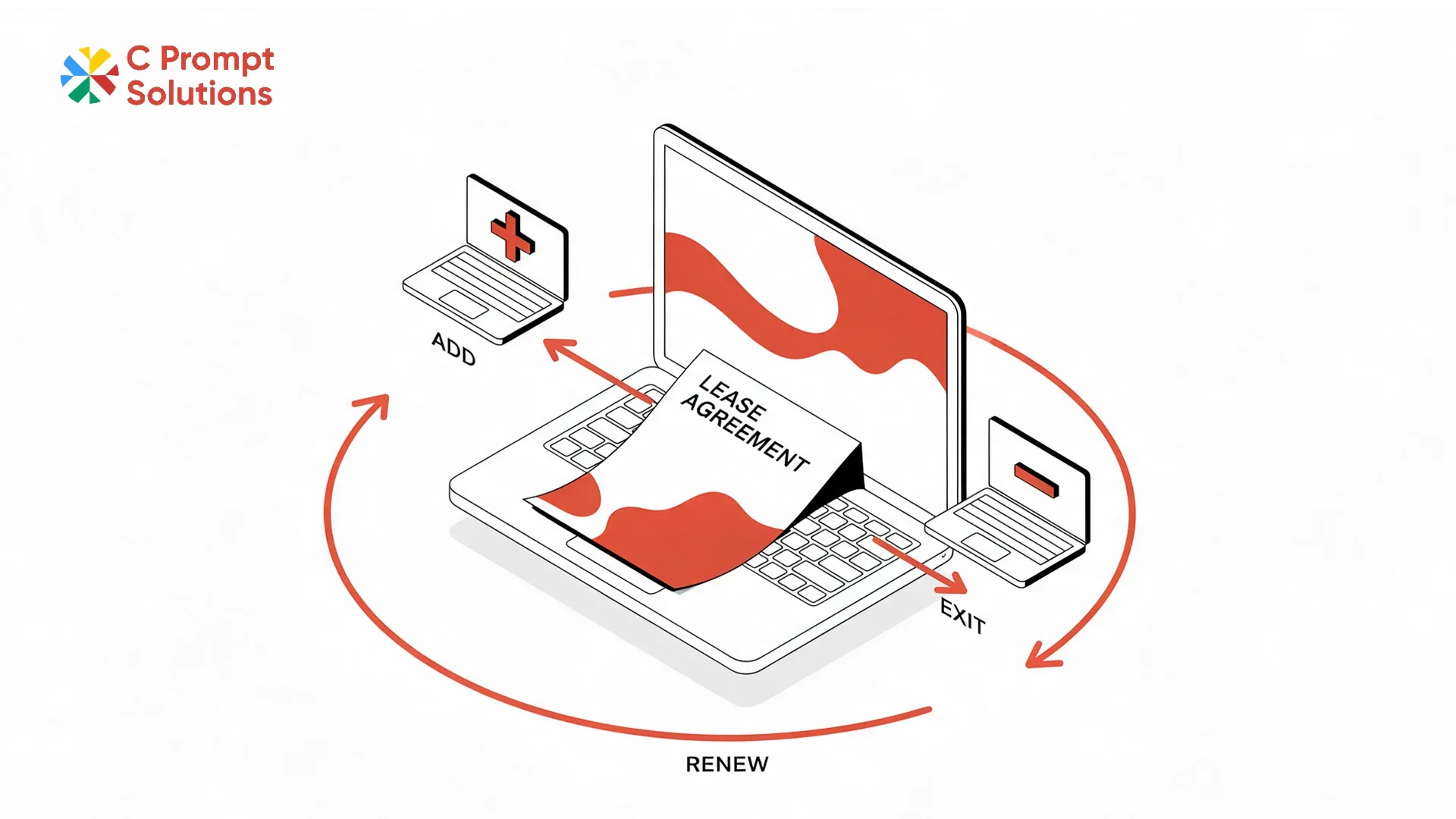
A laptop lease agreement is legally a contract of bailment under Section 148 of the Indian Contract Act, 1872, the same as a monthly rental. It is structured instead around a fixed multi-year term. Most disputes on a lease surface at three points. Devices are added mid-term, a business needs to exit early, or the term ends, and devices go through renewal or return. This guide runs through the questions to ask at each of those points, plus the notice window and refresh options in between.
What Fixed Term Means in a Laptop Lease Agreement
A fixed term is the length the monthly payment and device schedule are locked for, typically 2 to 5 years on C Prompt's Lease on Contract plan. Confirm the exact start date the term is calculated from. This is not always the delivery date. Some vendors calculate the term from the invoice date or the contract signing date instead. That can shift the end date by several weeks from what the delivery schedule suggests.
Device Schedule Is the Contract's Working Record
The device schedule lists every device on the laptop lease agreement: make, model, processor generation, RAM, storage and serial number. Ask how this schedule is updated when devices are added or swapped mid-term. A schedule kept only at signing, with additions tracked informally by email, becomes unreliable exactly when it matters most. That point is renewal or return.
Monthly Payment Terms to Confirm Before Signing
The monthly payment on a laptop lease agreement should stay fixed for the full term, per device, regardless of market pricing shifts. Confirm this in writing, along with the billing cycle and due date. Ask specifically whether the monthly payment changes when devices are added, and from which date the new payment applies.
Questions to Ask About Mid-Term Additions
Mid-term additions should be priced on the same schedule as the original order, not as a fresh negotiation each time. Ask whether added devices run to the same end date as the rest of the fleet, or start a separate term of their own. Fleets that add devices without aligning end dates often end up with several different renewal dates within a few years. This makes the annual review harder than it needs to be, since each addition then carries its own notice window and refresh timeline to track separately.
- Do added devices join the existing device schedule, or create a new one?
- Do added devices share the original end date, or start their own term?
- Is the monthly payment for added devices the same rate as the original order?
Questions to Ask About Early Termination
Early termination usually carries a charge calculated on the months remaining in the term. Ask for the exact formula in writing, not a general reference to "applicable charges." Confirm whether the charge reduces if devices are returned in good condition. Some vendors apply a flat rate regardless of return condition instead.
The Notice Window for Exit or Renewal
The notice window is how many days before the term ends a business must confirm exit, renewal, or a refresh request. Missing this window can auto-renew the lease on the original terms, whether or not that fits the business anymore. Confirm the exact number of days and who the notice must go to. Get this in writing at signing, rather than close to the actual end date.
Refresh Option Questions
A refresh option allows devices to be replaced with newer models partway through the term, usually at an adjusted monthly payment. Ask whether this is built into the original agreement or negotiated separately when the business wants it. A refresh option priced only after the request is made tends to cost more than one agreed at signing.
- Is a refresh option included in the original agreement, or added later at a premium?
- Does a refresh reset the fixed term, or continue the existing end date?
- What happens to the replaced devices: returned, disposed of, or repurposed?
Return Inspection at Laptop Lease End of Term
Return inspection at laptop lease end of term checks devices against an agreed condition standard. This decides what counts as normal wear versus chargeable damage. Section 160 of the Indian Contract Act, 1872 requires the return of goods once the agreed period ends, without a separate demand from the lessor. Confirm whether inspection happens on collection or afterwards. A delay changes who is responsible for damage found later.
Documents Required to Sign a Laptop Lease Agreement
Signing a laptop lease agreement in India needs standard KYB documents: company PAN, GST registration, and the signing authority's identification and authorisation letter. Larger fleets, or leases split across multiple offices, sometimes need one authorisation letter per billing entity. Confirm this early if the lease spans more than one registered office. Paperwork on a multi-year commitment is worth getting right the first time, rather than correcting it after signing.
- Company PAN and GST registration certificate
- Signing authority's identification and an authorisation letter
- One authorisation letter per billing entity, for multi-office leases
An IT Equipment Lease Agreement Covers More Than Laptops
A laptop lease agreement is one instance of a broader IT equipment lease agreement. The same contract structure covers desktops, monitors, servers and networking on one device schedule. If the fleet mixes laptops with other equipment, ask about combining contracts. Everything can often sit on a single IT equipment lease agreement rather than separate contracts per device type. One agreement, one schedule, is simpler to review at each notice window.
GST and TDS on a Laptop Lease Agreement
GST applies at 18% under CBIC Notification 11/2017-Central Tax (Rate), shown as a separate line on every invoice across the full lease term. Once monthly rent to a single vendor crosses ₹50,000, Section 194-I requires 2% TDS to be deducted before payment. Confirm both lines on a sample invoice before signing a term that runs several years.
Frequently Asked Questions
Can devices be added to a laptop lease agreement partway through the term?
Yes, most lease agreements allow mid-term additions. Confirm whether they join the existing device schedule and end date, or start a separate term of their own.
What happens if I need to exit a laptop lease agreement early?
Most agreements charge an early termination fee calculated on the months remaining. Ask for the exact formula in writing before signing, not after the business has decided to exit.
How much notice do I need to give before a laptop lease agreement renews?
This varies by vendor, so confirm the exact number of days in the notice window clause. Missing it can auto-renew the lease on the original terms.
Is a refresh option automatically included in a laptop lease agreement?
Not always. Some agreements build it in at signing, while others negotiate it separately when requested. Ask which applies before assuming a mid-term refresh is available.
What happens during return inspection at laptop lease end of term?
Devices are checked against an agreed condition standard to separate normal wear from chargeable damage. Confirm whether inspection happens at collection or afterwards.
Is GST charged on a laptop lease agreement?
Yes, at 18%, shown as a separate line on the invoice across the full term. Registered businesses can claim input tax credit on this amount.
Does TDS apply to laptop lease agreement payments?
Yes, at 2% under Section 194-I, once monthly rent to a single vendor crosses ₹50,000. Confirm which party handles filing before the first invoice on a multi-year term.
What documents do I need to sign a laptop lease agreement?
Standard KYB documents: company PAN, GST registration, and the signing authority's identification and authorisation letter. Larger fleets sometimes need one authorisation letter per billing entity.
Can two departments at the same company sign separate laptop lease agreements?
Yes, though most vendors prefer one master agreement with separate device schedules per department or cost centre. This keeps the notice window, monthly payment and refresh option consistent, while still letting each department track its own device count.
A laptop lease agreement comes down to questions asked at three points. Additions during the term, an early exit if needed, and the notice window, refresh option and return inspection at the end. Confirm all of these in writing before signing, not after the first addition or the first renewal deadline arrives.