
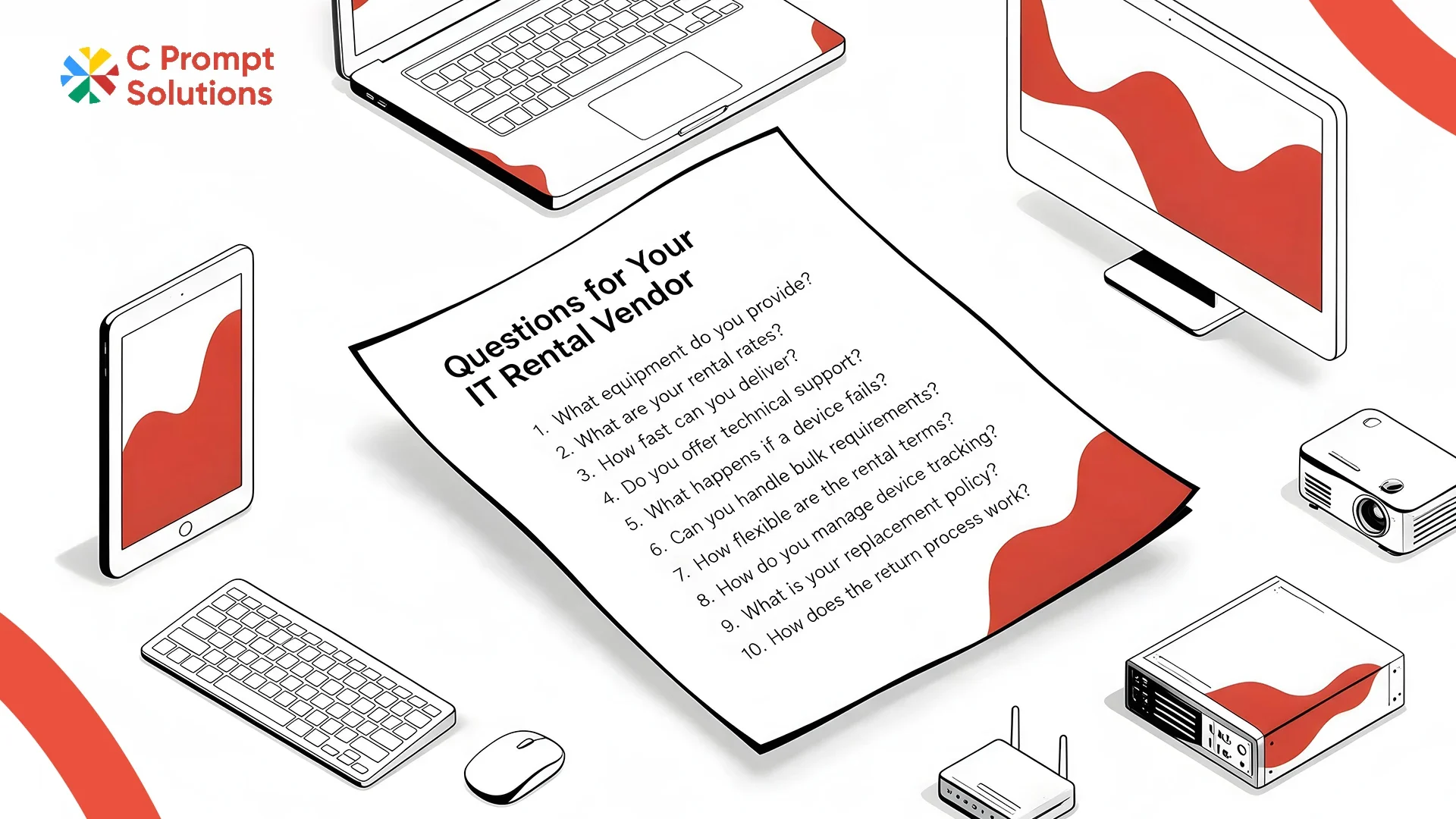
Every contract from IT equipment rental companies is legally a contract of bailment under Section 148 of the Indian Contract Act, 1872. That holds for whichever vendor issues it. The legal structure is identical across the market. What differs is how each company executes it in practice. Ten questions separate a vendor that executes well from one that only sounds like it does. This listicle runs through all ten, from equipment catalogue to asset return.
1. What Is Actually in the Equipment Catalogue?
An equipment catalogue that lists only laptops signals a company built around one device type. Ask for the full catalogue, including desktops, monitors, servers and networking gear, before assuming a vendor can grow with a mixed order later. A catalogue is a scope statement, not a marketing page. Ask specifically about brand range too. A catalogue naming Dell, HP, Lenovo and Apple under one contract signals genuine choice. A catalogue tied to a single OEM signals a reseller arrangement dressed up as a rental service.
2. Can They Run a Mixed Device Fleet on One Contract?
A mixed device fleet, laptops alongside desktops, monitors and servers, should sit on one contract with one schedule. Ask directly whether monitors, printers and networking gear can go on the same invoice as the laptops. A vendor that routes the answer to a different department usually means no.
- One schedule listing every device type, not separate contracts per category
- One invoice covering the whole order, not split billing across departments
- One point of contact for the full fleet, not one per device type
3. What Is Their Configuration Capability?
Configuration capability covers imaging, asset-tagging and staging before a device ships, beyond simply delivering a box. Ask whether devices arrive ready to log in, or whether IT staff need to configure each one after unboxing. The difference is a full day of internal IT time per batch on a rollout of any size. Ask, too, whether the vendor can apply your standard image at their facility. A vendor without this capability pushes that work back onto your own team on every order.
4. What Does Support Coverage Actually Mean?
Support coverage should name specific cities with local stock and field teams. A national claim that resolves to a call centre outside the delivery city is not the same thing. Ask which cities have local stock, and which are served from a regional hub instead. The second adds a day or two to any delivery or replacement.
5. Can They Show Delivery Evidence, Beyond Promises?
Delivery evidence means named client examples with device counts, cities and turnaround times, not a general SLA claim. Ask for two or three reference numbers: how many devices, how many cities, how fast. A vendor with real delivery history answers in specifics. One without it answers in adjectives.
6. What Are the Exact Replacement Terms?
Replacement terms should specify same-business-day or next-business-day in writing, tied to named cities. A general promise of support is not a service-level agreement. Ask what happens outside those cities, and whether the replacement device is imaged to the same build as the one it replaces.
7. What Does the Invoice Structure Look Like?
Invoice structure should separate the device rate, setup charges and applicable GST. Ask the vendor to show the GST classification, rate and amount clearly, so you can compare like-for-like quotations. Qualifying rent payments to a resident for equipment may require 2% TDS, subject to the ₹50,000 threshold for a month or part of a month and the applicable payer/payee conditions. For payment or credit events on or after 1 April 2026, consult Section 393 of the Income-tax Act, 2025 and the Income Tax Department’s transition guidance. TDS is withheld from the vendor payment and deposited with the government; it is not another vendor charge. Ask for a sample invoice before signing and have your finance team confirm the withholding treatment separately.
- Device rate, shown separately from setup and configuration charges
- Applicable GST classification, rate and amount shown separately from the device rate
- TDS applicability and withholding responsibilities confirmed with your finance team
8. Can They Provide Reference Deployments?
Reference deployments are real clients willing to confirm device count, duration and outcome, different from testimonials written by the vendor itself. Ask to speak with one existing client running a similar order size, in a similar city, before committing to a large rollout.
9. Is There a Seat Minimum?
A seat minimum forces a business to round up an order to meet a vendor's threshold. This is common among global providers gating entry at 1,000 seats or more. C Prompt's Monthly Rentals plan takes orders from a single device upward, with no such floor. Ask directly whether the vendor takes orders below that line, and whether pricing changes meaningfully at small volumes.
10. What Happens to Data and Assets at Return?
Data and asset handling at the end of a contract should include a certified data-wipe process and a documented return-condition standard. Neither should be an assumption. Ask for this in writing, including who is responsible if a device is not wiped correctly before reissue.
Laptop Rental Companies vs IT Equipment Rental Companies
Laptop rental companies and IT equipment rental companies are often the same business, described in two ways. The narrower term suits a business that only needs laptops. The broader term matters once monitors, servers, or networking gear enter the order. Run this same ten-question list against either kind of vendor, since the underlying contract structure does not change with the label.
The ten questions, in one list:
- What is in the equipment catalogue?
- Can they run a mixed device fleet on one contract?
- What is their configuration capability?
- What does support coverage actually mean?
- Can they show delivery evidence?
- What are the exact replacement terms?
- What does the invoice structure look like?
- Can they provide reference deployments?
- Is there a seat minimum?
- What happens to data and assets at return?
Frequently Asked Questions
What is a mixed device fleet?
A mixed device fleet is a single order combining more than one device type, such as laptops, desktops, monitors and servers. It runs on one contract, instead of separate agreements for each category.
Why does GST matter when comparing IT equipment rental quotes?
Compare both quotations on the same tax basis. Ask each vendor to state the applicable GST classification, rate and amount separately from the device charge. If tax is unclear or bundled into one quote, request an itemised version before comparing the totals.
How do I verify a vendor's delivery evidence?
Ask for specific numbers, device count, city, and turnaround time, tied to a named client where possible. A vendor unwilling to share any specifics is not offering evidence, only a claim.
Is a seat minimum common among IT equipment rental companies?
It is common among larger global providers, some of whom gate entry at 1,000 seats or more. It is far less common among India-focused vendors built to serve smaller and mid-sized orders.
What should a data-wipe commitment include?
Look for a certified data-wipe process and a named point of responsibility if it is skipped. Ask for confirmation in writing, since a verbal assurance during the sales conversation is not enough.
Should I ask about brand neutrality when comparing IT equipment rental companies?
Yes. A vendor offering Dell, HP, Lenovo and Apple under one contract gives a real choice per role or budget. A vendor tied to one OEM is functionally a reseller for that brand, whatever its marketing calls itself.
Does it matter if a vendor uses subcontractors for delivery and support?
It matters for accountability. A vendor using its own field teams can be held to the SLA directly. One using subcontractors often points to the subcontractor when a delivery or replacement runs late, which weakens the support coverage answer from question four.
Ten questions, asked before signing, tell you more about IT equipment rental companies than any brochure will. Catalogue, mixed fleet capability, configuration, support coverage, delivery evidence, replacement terms, invoice structure, reference deployments, seat minimum, and data return. Score each vendor on your shortlist against all ten, rather than the two or three that come up first in the sales call.