
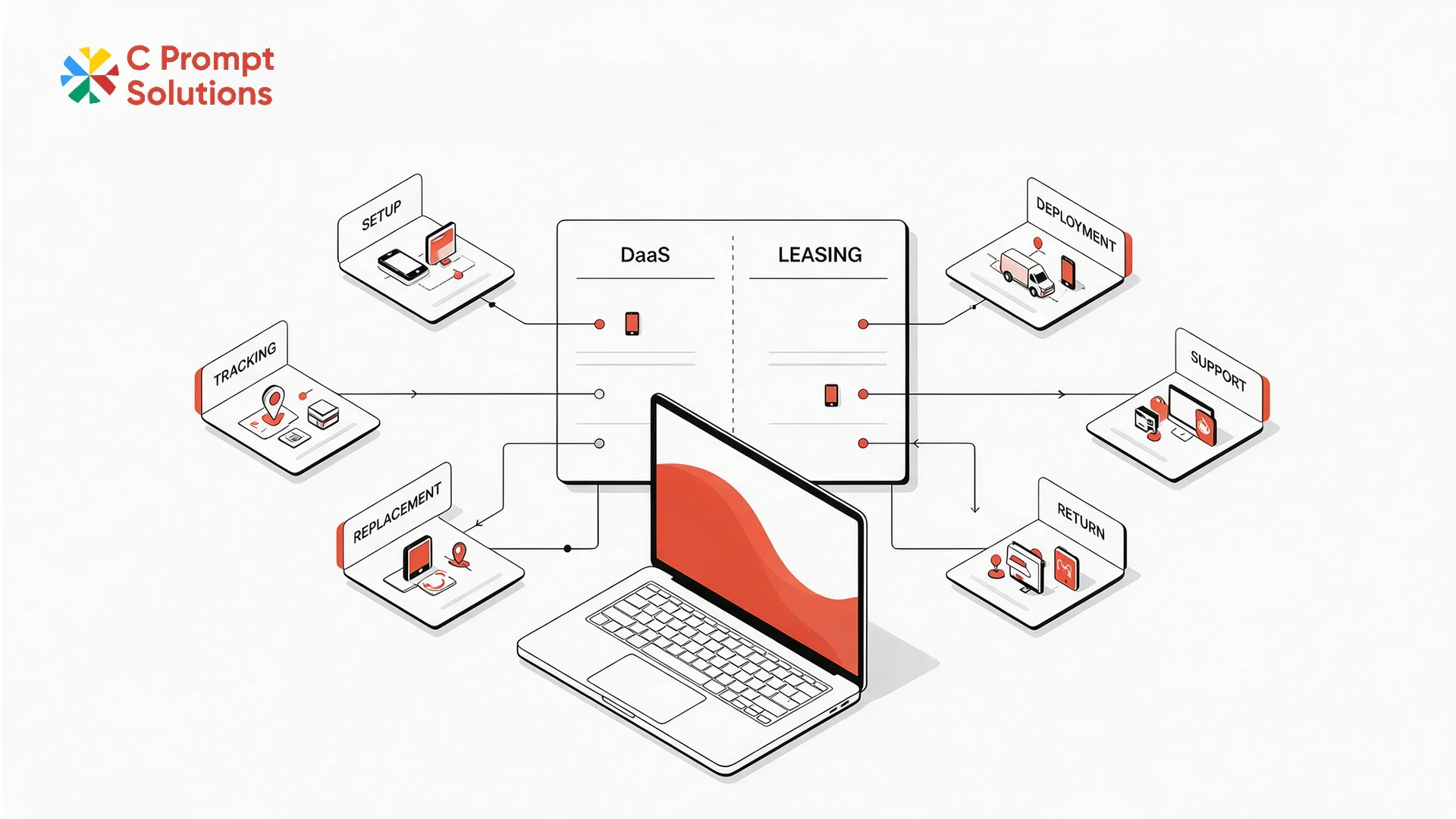
A lease and device as a service are both built on the same legal foundation. Under Section 148 of the Indian Contract Act, 1872, both are contracts of bailment, where the hardware stays the provider's property throughout the term. What differs is not the hardware arrangement underneath, but who handles each task around it: configuration, support, replacement, refresh and retirement.
Device as a service vs leasing comes down to that task list, not the hardware itself. This comparison walks through eight tasks and states plainly which model handles each one, so the choice comes down to fit, not guesswork.
Device as a Service vs Leasing: The Core Difference
A lease is fundamentally a hardware contract, with the client's own team typically running configuration, support and refresh alongside it. Device as a service is a hardware contract with those surrounding tasks bundled in as part of the service. Neither structure changes the underlying legal relationship. Both differ in how much of the task list sits with the provider versus the client's own team.
Contract Term
A lease runs on a fixed multi-year term, typically 2 to 5 years, set at signing and rarely adjusted once the fleet is deployed. Device as a service can run on a similar multi-year term. The contract is built around the managed relationship rather than a fixed hardware period, so term length is a smaller part of the conversation than what happens during it. Neither structure is faster to exit early; both carry an early-termination calculation based on months remaining.
Monthly Payment
On a lease, the monthly payment covers the hardware and stays fixed for the term, with support, replacement and other tasks priced separately or not included at all. Under device as a service, the monthly payment is built to cover the hardware plus the bundled tasks, configuration, helpdesk, replacement, reporting, refresh and retirement, as one figure. A lease quote and a DaaS quote are not directly comparable on the monthly number alone, since they are pricing different scopes of work.
- Lease: monthly payment covers hardware, fixed for the term
- DaaS: monthly payment covers hardware and the bundled service tasks together
- Compare scope first, then the monthly figure, not the other way round
Configuration Ownership
Configuration ownership on a lease often sits with the client's own IT team, unless configuration is specifically added as a paid extra. Under device as a service, configuration is typically part of the standard scope: devices arrive imaged to a defined build, asset-tagged and ready to log in. Confirm this explicitly either way, since "configuration included" means different things depending on which model is being quoted.
Deployment Responsibility
Deployment responsibility on a lease can go either way: some leases include delivery and setup, others deliver a box and leave installation to the client. Device as a service usually treats deployment, tracked delivery to the right desk, asset-tagged and logged against the fleet record, as a standard part of the service rather than an optional add-on. Ask this question directly rather than assuming either model includes it by default.
Helpdesk Scope
Helpdesk scope is one of the clearest differences between the two. A lease typically does not include a helpdesk; support beyond hardware replacement usually sits with the client's own IT team. Device as a service usually bundles helpdesk support into the same monthly price, so employees have one point of contact for both hardware and basic software issues.
- Lease: helpdesk usually not included; hardware replacement handled separately
- DaaS: helpdesk typically bundled into the monthly price
- Ask specifically what "support" covers on a lease before assuming it means helpdesk
Replacement Logistics
Replacement logistics on a lease should specify an SLA in business days, the same as any equipment rental. The client's own team is often responsible for reporting the failure and coordinating the swap. Device as a service typically monitors and manages replacement as part of fleet reporting. A failure gets flagged and addressed as part of the ongoing service, rather than something the client has to notice and escalate independently.
Refresh Responsibility
Refresh responsibility on a lease is usually a conversation that happens at renewal, once the original term is ending, rather than a scheduled event built into the contract from day one. Device-as-a-service more often plans refresh proactively, tied to a device's useful life, spreading replacement across the contract term. Schedule II of the Companies Act, 2013 sets that useful life at 3 years for laptops, a figure both models eventually work against, whether planned upfront or negotiated later.
Retirement Process
Retirement process on a lease typically means the client returns devices at the end of term, with the provider handling data wipe and disposal from that point. Device as a service usually manages retirement as an ongoing task throughout the contract. Individual devices reach end of life and get replaced continuously, rather than all at once at a single term-end date. Confirm the certified data-wipe process either way, since this responsibility should never default to being unstated.
GST and TDS Apply the Same Way to Both
GST applies at 18% under CBIC Notification 11/2017-Central Tax (Rate) on both a lease and device as a service, shown as a separate line on the invoice regardless of which model is chosen. Once monthly payment to a single vendor crosses ₹50,000, Section 194-I requires 2% TDS to be deducted before payment. The same threshold applies to either contract type. Tax treatment does not factor into the choice between the two.
Which One Fits Which Situation
A lease fits a business with its own IT team already handling configuration, support and refresh, that mainly wants predictable hardware cost over a multi-year term. Device as a service fits a business that wants those surrounding tasks handled as part of the contract, not run internally. Neither is the default choice. The right one depends on how much of the task list a business wants to keep in-house versus hand to the provider.
IT Equipment Leasing Beyond a Single Device Type
IT equipment leasing covers the same task comparison whether the fleet is laptops alone or a mix of desktops, monitors and servers. C Prompt's Lease on Contract plan runs a mixed fleet on one device schedule, the same way device as a service does. The task-by-task comparison above applies equally regardless of device type, since the difference between the two models sits in the service layer, not the hardware category.
Frequently Asked Questions
Does a lease include helpdesk support?
Usually not by default. Most leases cover hardware and a replacement SLA, with helpdesk support sitting outside the contract unless specifically added.
Is device as a service more expensive than leasing?
The monthly figure is often higher because it covers more tasks. Compare scope first: a lease quote and a DaaS quote price different amounts of work.
Who handles device configuration on a lease?
Often the client's own IT team, unless configuration is added as a specific line item. Confirm this before assuming it is included.
Does device as a service handle refresh automatically?
Typically, it plans refresh proactively against a device's useful life, rather than waiting for a renewal conversation, though the exact schedule should be confirmed in the contract.
Is GST or TDS different between a lease and device as a service?
No. Both carry 18% GST and the same 2% TDS threshold under Section 194-I once monthly payments cross ₹50,000.
Can a business switch from a lease to device as a service later?
Generally yes, at contract renewal. The underlying hardware relationship is similar enough that moving between models does not require starting from zero.
What is the simplest way to decide between device as a service vs leasing?
List the eight tasks, configuration, deployment, helpdesk, replacement, refresh and retirement included, and mark which ones the internal team already handles well. What is left over usually points to the better fit.
Device as a service and leasing both sit on the same hardware arrangement underneath. The real comparison is task by task: contract term, monthly payment, configuration, deployment, helpdesk, replacement, refresh and retirement. Match these against how much a business wants to run internally before choosing between the two.